|
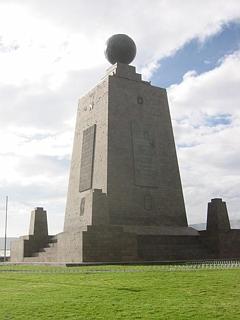
After more hours asleep than awake for two days, I join my fellow hostel guests in our shared dining room for a $0.60 breakfast. Two eggs, steaming croissants and hand-made marmalade, piping hot milk and cool fresh-squeezed orange juice later we hop into our proprietor's/chef's/tour guide's Jeep and head for the back country. Our first stop of on the way out of Quito is "El Mitad del Mundo" (the center of the world) -- a grand monument set 800 meters north of the equator (the French explorer's weren't quite as accurate as the buried Incan ruins 800 meters to the south).
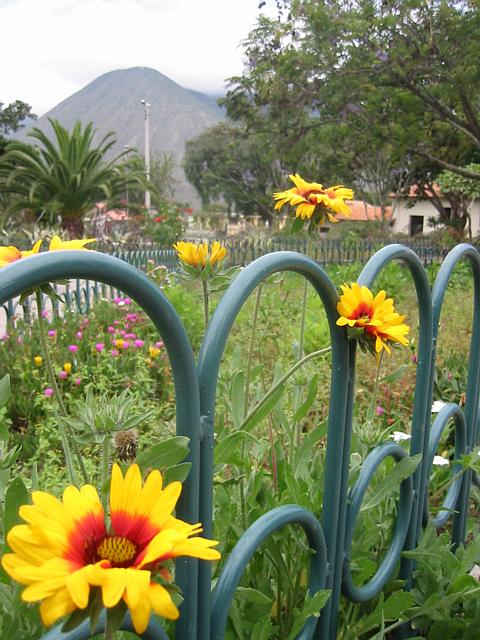
From there we turn off a big road to a small road, and then to a dirt road used only by mining trucks and us. Up and down we cut back across the steep sides, encountering a wild fox as a reward for our troubles. As we press on, the dirt quarry road narrows to be a muddy single lane, and then to what's little more than a wide mountain path requiring all four wheels, though rarely at the same time. Enduring ceaseless josteling and staggering mountain vistas, we pullinto a small village accessible only by our very route. Simply a church square of incredible flowers, we're told that most residents visit Quito -- just an hour away by jeep -- perhaps twice in their lives.
Returning to our private jungle trail we begin to encounter local construction workers building miles of cobblestone roads, by hand, to make the bouncy trek somewhat more bearable. Our next stop is Otavalo, a small town known for its exceptional indiginous market. There we split up for two hours, lunch being the highest priority on my mind.
I wander a bit before giving into food, though having little money and no space in my pack, my wandering doesn't last long. As the foreboding clouds turn to rain, I step into an unmarked restaurant for my first true Ecuadorian meal.
Now, at the time of this writing a week after leaving Ecuador, I still don't know what is Ecuadorian food. Everywhere I go I see restaurants offering pizza, hamburgers, filet mignon, fruit salads, curries, stir fry -- every ethnicity of food but here. But as far as I can tell Ecuadorians eat soup, as every meal I get seems to come with a bowl. This meal is no exception. After giving up on trying to understand what I'm ordering, I just start saying "Si" until she stops asking questions. First to arrive is the requisite soup, in which sits a large cross-section of some large animal. The soup itself is excellent, though I steer clear of the strange leg bone, as nobody else seems to be eating it. Next is the main course, consisting of beef marinated in a sweet tomato sauce, plantains, rice, bright-orange chicken fixed in a style that doesn't suit me, and some unidentifiable potato-like substance. All this was washed down with a ubiquitous Coca-Cola at a price of $2USD.
We leave Otavalo soon after, only to immediately break down near a toll booth (apparently the mechanic forgot that bolts taken out of an engine are supposed to be put back in). At this point I get into a rousing and extremely edcational discussion of politics with one of the two other guests, a member of the Canadian foreign ministry (who happens to have been intimately involved with the Somolian conflict that led to the Black Hawk Down incident). This conversation continues through the repair, into and out of a volcano's crater lake, through an incredible sunset, and on the long trip home. This time, by highway.
|