|
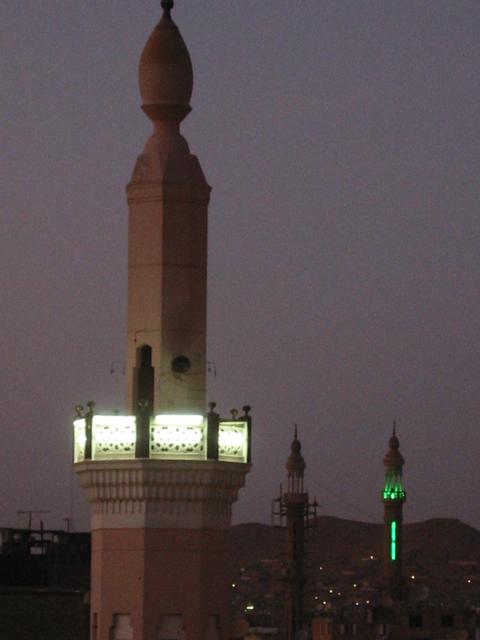
Perhaps my favorite truly Egyptian (well, truly Islamic) aspect of Egypt is the mosques calling the faithful to prayer. Starting at 4am and repeating perhaps every six hours thereafter, grotesquely beautiful, tortured cries pour from the minarets in an intricate and, to my ear, incredibly foreign song of prayer. Now these words I use are generally reserved for terrible moments of intense pain and sadness, but that's the only way I can describe something so completely unusual to me. The tones, the tempos, the words - nothing matches anything that I've been conditioned to recognize, though this does not diminish the complete peace the songs inspire.
Now, it's widely known that Muslims pray several times a day (four, I think). I naturally assumed that everyone was supposed to pray when the called from the minarets. However, this is not the case. Rather, the minarets divide the day into periods during which prayers must be performed, giving a great deal of flexibility to the individual to choose precisely when to pray. Furthermore, I generally assumed that mosques were reserved for a special day (such as Sunday in Christianity, though Friday is the big Islamic day), and that prayers on other days were done from anywhere. However, prayers outside the mosque are generally only done when it's not possible to go (in the field, on a boat, traveling) - if you can arrange to be at a mosque, that's where you should go. Thankfully there are mosques in great supply, and as far as I can tell there doesn't appear to be much variation between one another: the prayers are more or less fixed depending on the day and time.
But, most of this is just pieced together from fragments I picked up from different people, so I may be way off. There are other aspects that I simply do not get at all. For example, some nights (and not necessarily just on Friday) they assemble these giant outdoor rooms out of metal tubing, huge carpets and tapestries, and ornate silver lamps. Generally (though not always) placed next to a mosque, they hold a number of seats in four columns, almost as if it's a waiting room to see the man at the very front, whose prayers are magnified to incredible volumes by their microphones and speakers. It's an intensely colorful affair, but one that eludes my understanding.
|